How to Get WiFi in a Garden Office or Garden Room (That Actually Works)
Zak
1 November 2026
→ Get WiFi To Your Garden Office, Fixed Price
You've built the garden office. The desk's in, the heater works, and the view beats the spare room. Then you join your first video call and the screen freezes.
Garden rooms are one of the hardest places to get WiFi, because the signal has to leave your house, cross the garden, then get into a building that's often insulated with foil-backed boards.
The good news is it's very fixable. Here are your options, best first.
Key Takeaways
- A cabled access point in the garden room is the most reliable option
- Fibre is ideal for long runs and has no electrical link between buildings
- A point-to-point bridge is the best choice when you can't run a cable
- Mesh can work over short gaps, but isn't dependable
- Plug-in boosters rarely work across a garden
- Foil-backed insulation can block signal almost completely
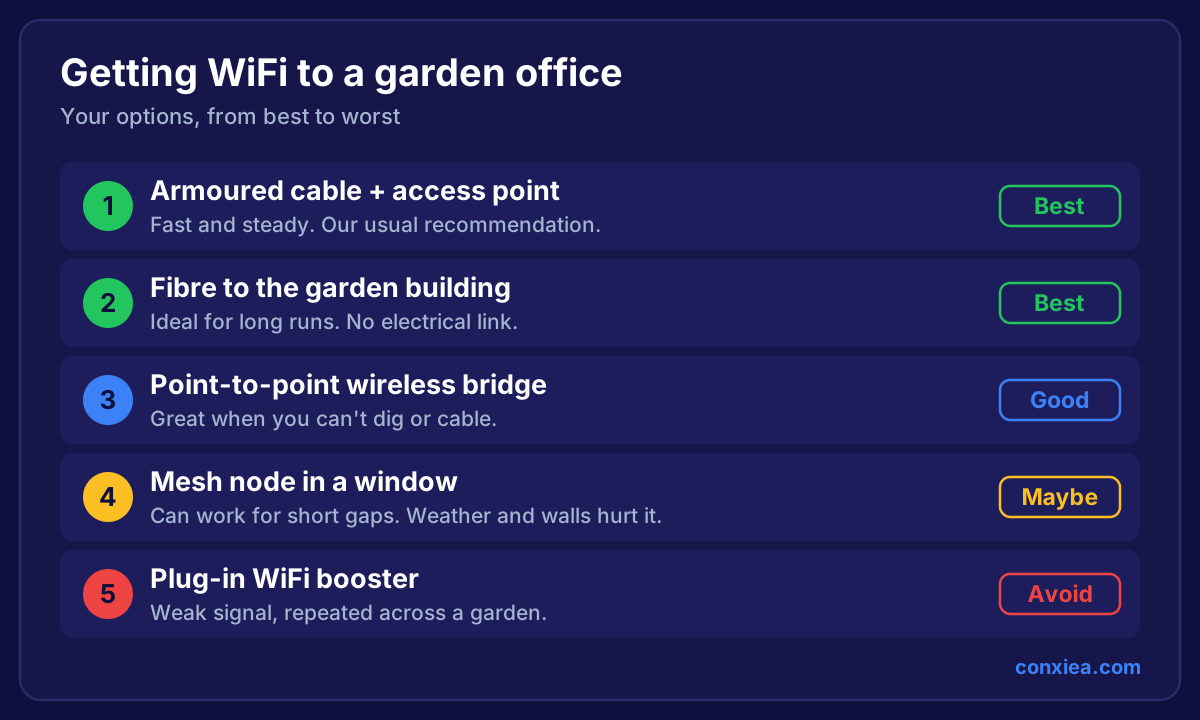 Ranked list of garden office WiFi options: armoured cable with access point, fibre, point-to-point wireless bridge, mesh node in a window, and plug-in WiFi booster
Why Garden Offices Are So Hard to Reach
Three things work against you:
- Your outside wall: the signal has already lost strength before it leaves the house
- Distance: every metre across the garden weakens it further
- The building itself: many garden rooms use foil-backed insulation, which is great for heat and terrible for WiFi
This isn't just about comfort either. If it's your place of work, a dropped call is a real problem.
Option 1: Armoured Cable and an Access Point (Best)
A cable runs from your router to the garden office, and an access point inside gives you strong WiFi in the room. Your garden room gets the full connection, as though it were another room in the house.
Why it works: nothing has to travel through the air across the garden.
Things that matter:
- Use proper external-grade cable. Indoor cable breaks down outside
- Armoured cable is much tougher if it's buried or runs along a fence
- Ethernet has a limit of 100 metres per run, which covers most gardens
- Plan it before you lay the patio, if you can
If you're having a garden room built, ask the builder to lay a duct for you. It's a very cheap job during the build, and much harder afterwards.

Option 2: Fibre to the Garden Building (Also Best)
Fibre between the house and the garden room does the same job as Ethernet, and it can go much further. It carries light, not electricity, so it also keeps the two buildings electrically separate.
It costs more than copper, and it isn't needed for most gardens. It's the right choice for long runs or larger properties with outbuildings.
Option 3: Point-to-Point Wireless Bridge (Good)
When you can't dig or run a cable, a pair of small outdoor antennas can link the house and garden room. One sits on the house, and the other on the garden building, aimed at each other.
Why it works: it's a focused beam rather than WiFi spreading in all directions, so it holds up far better than a booster.
It needs a clear line of sight, so trees and sheds can get in the way, and it needs fitting properly. Used in the right place, it's a really good option.
Option 4: Mesh Node in a Window (Maybe)
A mesh unit in a window on each side can bridge a short garden. It can work, but weather, leaves, a closed blind or a foil-lined wall can knock it out. Don't rely on it if you work from there every day.
We compare mesh in more detail in extender vs mesh vs wired access points.
Option 5: Plug-In WiFi Booster (Avoid)
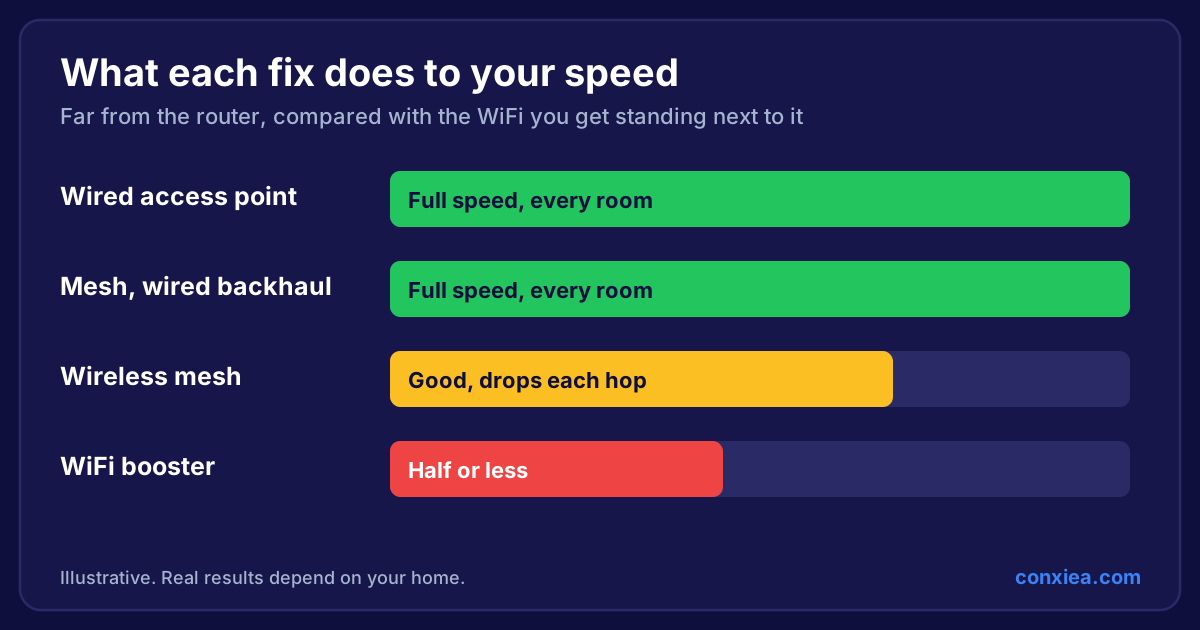
It's the first thing most people try, and the least likely to work. To reach the garden room, a booster needs a good signal, but by the back of your house the signal is already weak. Then it has to pass that through two outside walls.
You can get full bars and an unusable connection. We explain why in the 7 downfalls of WiFi boosters.
What About Powerline?
Powerline adapters send data over your mains wiring. Garden rooms are often on a separate circuit, and sometimes a separate consumer unit, which can make powerline slow or unreliable. It's worth a try if you already own some, but we wouldn't plan around it.
Getting WiFi Into the Rest of the Garden
Once you've got a cable out there, you can do more with it:
- An outdoor access point gives you WiFi on the patio, or by the hot tub
- It can connect outdoor cameras and lights, which we cover in our smart home WiFi guide
- Power over Ethernet can supply the access point through the same cable, so you don't need a socket beside it
Choose outdoor kit with a proper weatherproof rating, because indoor access points won't survive a South West winter.
As for WiFi 7, it's nice inside the garden room, but its 6 GHz band won't help you cross the garden.
Before You Start: A Quick Checklist
- How far is it from your router to the garden room?
- Can a cable run along a fence, or does it need burying?
- Is there insulation with a foil backing?
- Do you have power out there already?
- Will you be working there daily, or using it now and then?
Any mains electrical work should be done by a qualified electrician. Low-voltage data cable is a separate job, and we can arrange it around your electrician's work.
Frequently Asked Questions
Will my WiFi reach my garden office?
Sometimes, if it's close and the building isn't foil-insulated. Most of the time you'll need to bring a connection out to it.
Do I need separate broadband for a garden office?
Usually not. A cable or bridge from your house shares your existing connection, which is cheaper and simpler than a second line.
Is a WiFi booster enough for a garden room?
Rarely. It would be repeating a signal that's already weak by the time it gets to the back of your house.
Can I bury normal Ethernet cable?
No. Use external-grade cable, ideally armoured. Indoor cable won't last outside.
Want your garden office working as well as your house?
We run the cable, fit the access point and test it before we leave. One fixed price, cables kept tidy, and if it isn't fixed, you don't pay. We cover homes across the South West.
→ Get A Home WiFi Installation
Or talk to a local home WiFi installer about your garden room.
For the rest of the house, see what your home WiFi should be doing.