Why Your Beer Garden Has No Signal (And How to Fix It)
Zak
9th August 2026
Walk from the bar to the beer garden of most pubs and watch the WiFi bars drop off your phone in real time. It's such a common experience that customers barely comment on it anymore, they just accept that outdoor seating means no signal. It doesn't have to be that way, and the reason it usually is comes down to one predictable design mistake.

Why Outdoor Areas Are Almost Always Dead Zones
The answer is usually simple: outdoor coverage was never actually designed, it just happens to reach that far, or it doesn't. WiFi blackspots are common across venues, especially outdoors, because a single indoor router positioned for the bar and dining room was never going to reliably reach through solid walls to a garden thirty feet away.
Physical obstacles make it worse. Metal objects, vehicles, outdoor furniture frames, aluminium patio sets, create additional dead zones, and dense landscaping, mature trees, and solid garden walls or fencing further block signal that's already struggling to get through the building's exterior wall in the first place. None of this is unusual or unlucky, it's simply what happens when outdoor coverage isn't planned for from the start.
Why It Actually Matters for Revenue, Not Just Convenience
It's tempting to treat this as a minor guest-comfort issue. Customers now expect connectivity in beer gardens, terraces, courtyards, and smoking areas, and a beer garden is often where a pub's food and drink orders are actually taken via table-service apps or QR-code menus. If that connection doesn't reach the garden reliably, the ordering system it depends on doesn't work either, turning a WiFi gap into a lost-order problem.
What Actually Fixes It
Purpose-built outdoor access points, not an indoor router pointed hopefully outward. Beer gardens and terraces need IP67-rated access points engineered specifically to withstand rain, temperature swings, and being genuinely outdoors day after day, not consumer equipment never designed to leave a shelf indoors.

A proper site survey covering the outdoor space specifically. Professional wireless site surveys and heatmap analysis identify actual coverage gaps before installation, rather than discovering them after a customer complains from the far end of the garden.
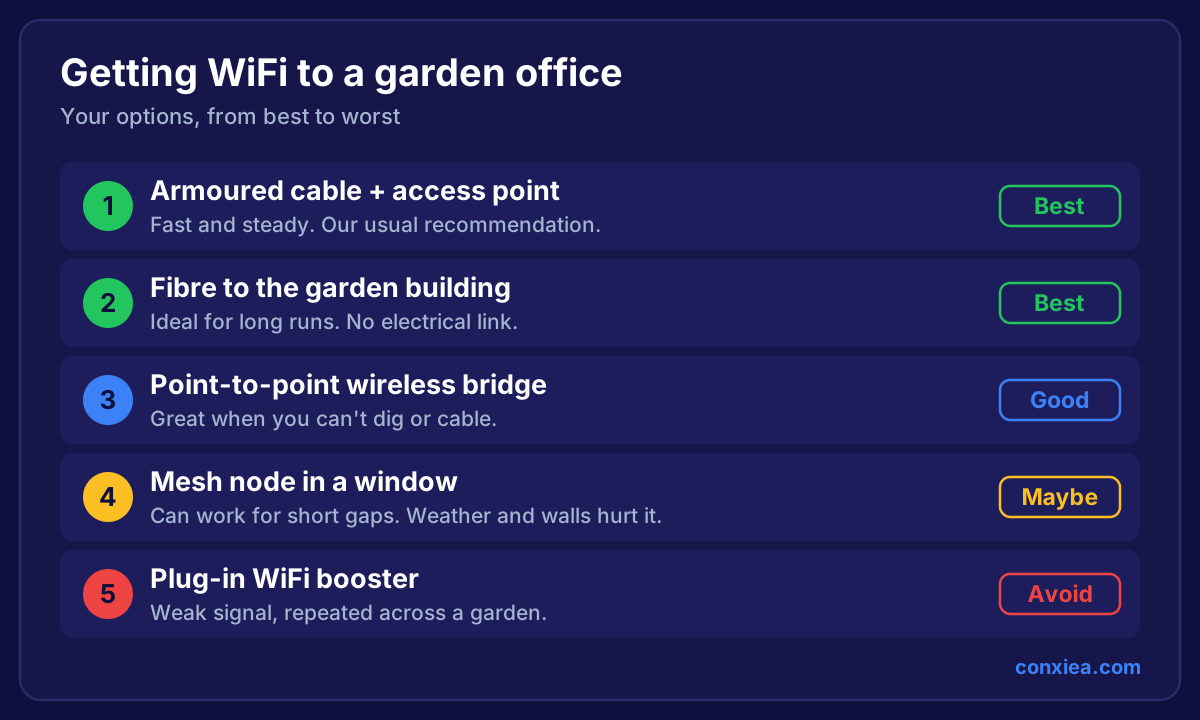
Structured cabling to outdoor access points, not a mesh extension of the indoor network. Structured cabling connecting access points directly back to the network outperforms mesh systems, which tend to add latency and lose performance the further they extend from the original router, exactly the problem that leaves gardens with a weak, unreliable signal.
Coverage planned around actual seating layout, not the building's floor plan. A garden with tables spread across 40 metres needs access points positioned for where people actually sit, not a single unit mounted near the back door.
The Business Case Is Simple
Outdoor seating is usually a pub's highest-margin real estate during good weather, more covers, higher turnover, less pressure on indoor space. Treating its WiFi as an afterthought undermines exactly the part of the venue doing the most work on a sunny Saturday.
Where Conxiea Fits
Conxiea designs outdoor coverage as part of the original network plan for every pub installation, not a retrofit, weatherproof access points, proper site surveys, and cabling built to actually reach the garden, not just the bar.
Book a free site survey to see exactly where your dead zones are →